
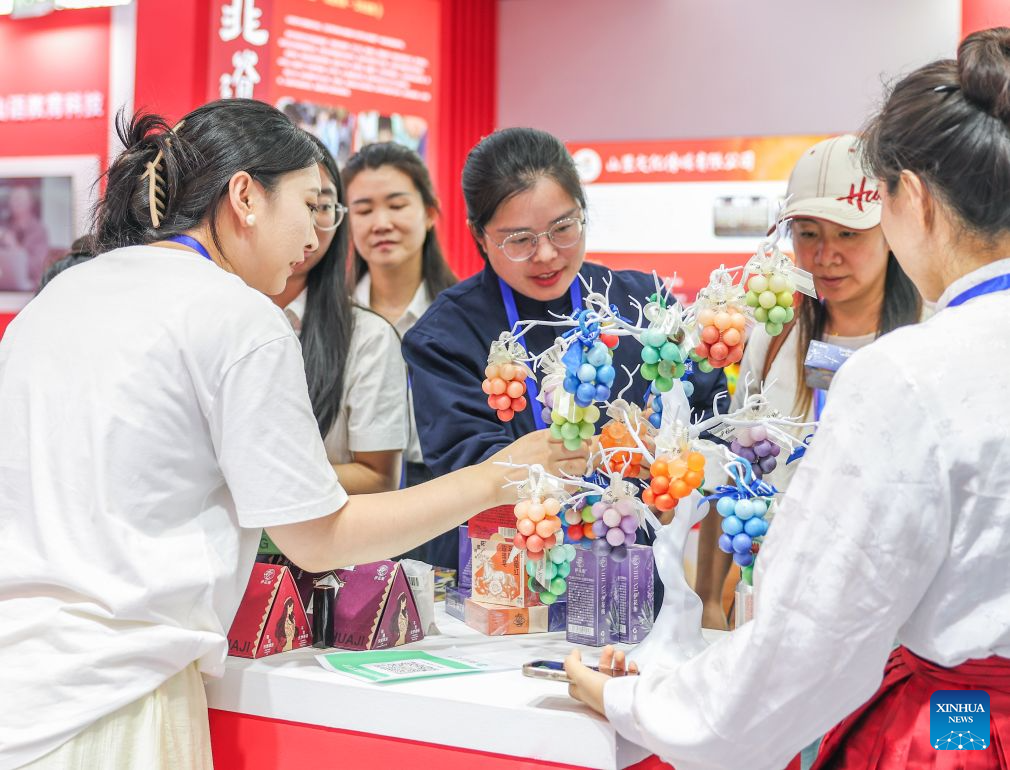
Exhibitors participating in an entrepreneurship competition present their products during an exhibition in Hefei, east China's Anhui Province, July 29, 2026. (Xinhua/Chang Nengjia)
HEFEI, Aug. 2 (Xinhua) -- From Chinese-style music to smart glasses, an array of eye-catching startup projects turned an exhibition center in Hefei, capital of east China's Anhui Province, into a vibrant showcase of innovation and creativity this week.
The exhibition was a sideline event of the national finals of an entrepreneurship competition co-hosted by the Ministry of Human Resources and Social Security and the Anhui provincial government.
Over four days through Friday, some 600 entrepreneurs from participating projects presented their ideas and demonstrated their products to judges and visitors.
The showcase offers a glimpse into China's evolving entrepreneurial landscape. With growing support ranging from financial incentives and free workspace to training programs and incubation services, the country's expanding startup ecosystem is helping aspiring entrepreneurs turn ideas viable businesses.
Among the participants is Wu Shuping from Jiangxi Province in east China, who presented a digital replica project that recreates porcelain cranes inspired by traditional root-carving artworks.
"The design came from a root-carving master," Wu said. He scanned the master's artworks into digital 3D models and then used 3D printing technology to produce porcelain molds, followed by manual carving, glazing and high-temperature firing.
The approach has improved production efficiency and helped the master explore a new art form, he said.
Wu's real ambition is turning intangible cultural heritage into digital assets. The master carver's techniques and creative details are converted into reusable 3D files, which can be sold on his platform to museums, designers and overseas clients. With the help of artificial intelligence (AI), users can further modify the designs and explore new creative possibilities.
Through digital replicas, traditional crafts are finding new commercial value and reaching wider global audiences.
Wu said his confidence comes from support from local authorities. "The government helped us find a great venue and introduced us to an AI large language model team," he said, adding that his team plans to use AI in research and development, design and management in the future.
Zhang Mengni, a 37-year-old contestant from Anqing City, Anhui Province, received help from the local entrepreneurial ecosystem before transforming a traditional brush-making business into a technology-driven enterprise.
Growing up in a township home to thousands of brush makers, most of which are small family workshops, Zhang initially faced disagreements with her father, a veteran brush maker, over the business direction.
The turning point came from government-organized entrepreneurship training. Visits to universities in Shanghai and Zhejiang Province broadened her horizons and strengthened her resolve to innovate.
In partnership with university researchers and laboratories, her team developed a photovoltaic panel cleaning robot with autonomous navigation and visual obstacle avoidance capabilities.
"As clean energy like photovoltaics expands, demand for photovoltaic panel cleaning is also rising," Zhang said. Her products have been exported to 63 countries, and the project has created over 1,200 jobs along the value chain.
Behind these individual entrepreneurial stories lies a broader effort to strengthen entrepreneurship as a driver of employment and economic growth. In recent years, China has continued improving policies to support entrepreneurship, including targeted support for key groups.
Data shows that in recent years, over one million entrepreneurs apply for and receive interest-subsidized guaranteed entrepreneurship loans each year. During the 14th Five-Year Plan period (2021-2025), China added an average of more than 10 million new business entities annually.
Organizers of the competition said they plan to encourage entrepreneurship with comprehensive support spanning funding, incubation programs and skills training to help turn creative ideas into businesses.
"New technologies, industries, business forms and models keep emerging, offering entrepreneurs broader market space and more opportunities," said Li Yu, a researcher with the Chinese Academy of Personnel Science.
China's package of policy support could help boost entrepreneurs' enthusiasm and success rates, creating a virtuous cycle between high-quality entrepreneurship and employment, and high-quality development, Li added. ■
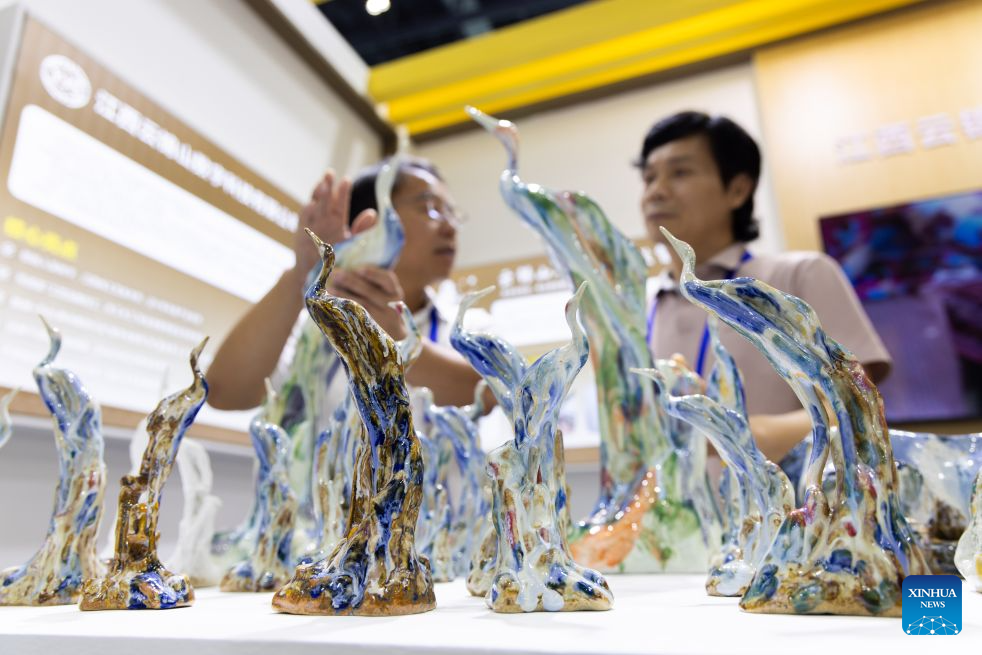
Wu Shuping (L) presents porcelain cranes during an exhibition in Hefei, east China's Anhui Province, July 29, 2026. (Xinhua/Zhao Jinzheng)


